


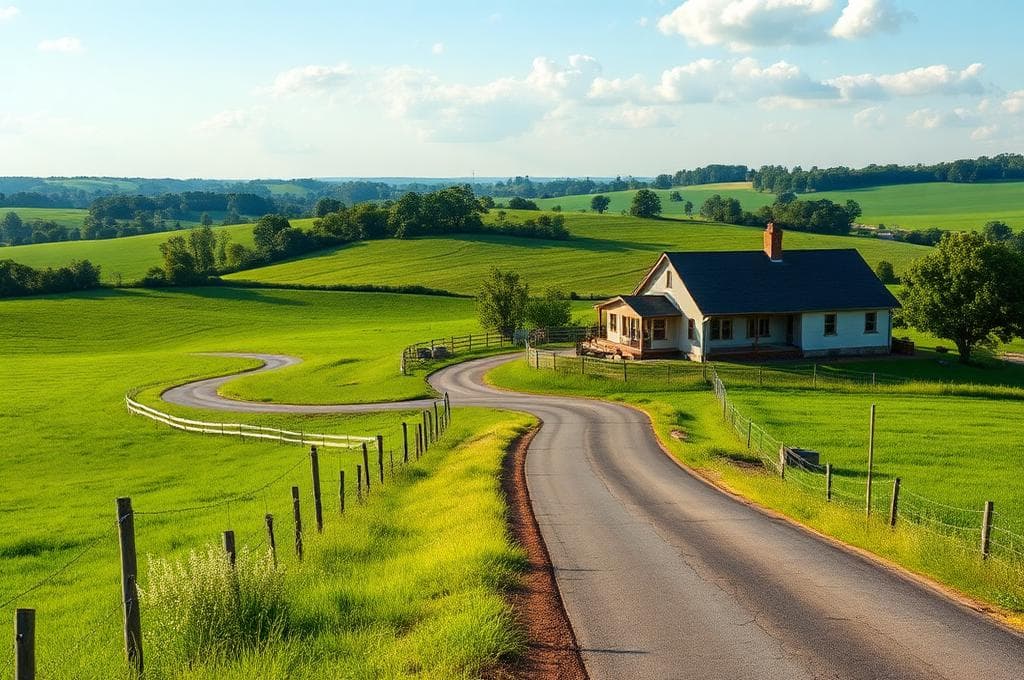
USDA loans offer zero-down financing and no mortgage insurance for homes in eligible rural and suburban areas. Understand who qualifies and whether your target area is eligible.
Key Takeaways
- USDA loans offer zero-down financing and no mortgage insurance in eligible rural and suburban areas
- You must meet income limits (115% of area median income) to qualify
- Guarantee fee (2% upfront + 0.35% annual) is the cost; much lower than conventional PMI
- Approximately 97% of U.S. land is eligible, but urban cores are excluded
- USDA is ideal for rural and suburban buyers with limited down payments and moderate credit
What Is a USDA Loan?
Getting the right financing is about more than just the numbers—it's about having confidence in a decision that will affect your family for years. Let us simplify it for you.
A USDA loan is a mortgage backed by the U.S. Department of Agriculture. It's designed to promote homeownership in rural and suburban areas by offering zero-down financing and no mortgage insurance.
The program is officially called the USDA Single Family Housing Loan Program. Unlike VA loans (for veterans), USDA loans are for any qualified buyer in an eligible area.
The key benefits mirror VA loans: zero down, no mortgage insurance, competitive rates, and flexible credit requirements.
Who Qualifies for a USDA Loan?
You must meet three criteria:
1. Income limits: Your household income cannot exceed 115% of the area median income. In rural areas, this might be $65,000-$100,000 depending on family size and location.
2. Credit requirements: Minimum credit score is typically 580-620. USDA loans are flexible with past credit issues, especially if explained.
3. Eligible property location: The home must be in a USDA-eligible area. Approximately 97% of the U.S. land area is eligible, but it excludes most urban areas and many suburbs.
Is Your Target Area Eligible?
This is the critical question. Check USDA eligibility at rd.usda.gov or ask your lender. Roughly:
- Eligible: Rural areas, small towns (under 10,000-20,000 population), most suburban areas beyond the immediate metro area.
- Not eligible: Major metropolitan areas, dense urban cores, areas with high population density.
Example: A home in rural upstate New York is likely USDA-eligible. A home in suburban Boston near the city center is probably not. Your lender can verify in seconds.
USDA Loan Benefits
Zero down payment: Just like VA loans, you put down $0 and finance 100% of the purchase price.
No mortgage insurance: USDA loans don't require PMI. This saves $150-$400/month.
Competitive rates: USDA rates are among the lowest available. In 2025, USDA rates might be 6.0-6.3% while conventional is 6.5%.
Flexible credit: Credit scores as low as 580 are acceptable. Past credit issues are forgivable with explanations.
No prepayment penalty: Pay off early without penalty.
Assumable loans: Future buyers can assume your USDA loan, making your home more attractive if you sell.
USDA Loan Costs: Guarantee Fee
Like VA loans, USDA loans have a one-time "guarantee fee" instead of mortgage insurance:
- Upfront guarantee fee: 2.0% of the loan amount (paid at closing)
- Annual guarantee fee: 0.35% of loan balance annually (built into your payment)
Example: $300,000 USDA loan = $6,000 upfront fee + $0.35% annually. Total cost is similar to PMI but with added annual component.
The total cost is reasonable compared to conventional loans with PMI, especially since you're putting down zero while conventional requires 3-5%.
USDA Income Limits
Income limits are based on family size and county. These limits change annually and are typically 115% of area median income:
- Rural county with median income $65,000: Limit might be $74,750 (115%)
- Suburban county with median income $95,000: Limit might be $109,250 (115%)
If your household income exceeds the limit for your county, you don't qualify, even if creditworthy. Conversely, if you're above-average income but in a rural area with low median income, you might not qualify.
Check your specific county's limit at rd.usda.gov. Income limits vary significantly by location.
USDA Loan Appraisal and Property Standards
USDA appraisals are similar to VA appraisals. The property must be safe, sanitary, and in good repair. Major issues (roof replacement needed, foundation problems, significant water damage) must be resolved before closing.
One unique requirement: The home must have a safely functioning water and septic system (or be connected to public utilities). Wells and septic systems must be inspected and approved.
USDA vs. Conventional: When USDA Makes Sense
On a $300,000 rural home:
- USDA (6.2% rate, $6,000 guarantee fee): Loan $306,000, payment $1,862/month (including annual guarantee fee). No down payment needed.
- Conventional (6.5% rate, 5% down, PMI): Down payment $15,000, loan $285,000, payment $1,807 + $200 PMI = $2,007/month.
USDA saves: $15,000 down payment + lower payment = significant savings, even with upfront guarantee fee.
USDA makes sense if: Your target home is in an eligible rural or suburban area, your income is below the area limit, you have limited down payment savings, and your credit is moderate (580-650).
Self-Employment and USDA Loans
Self-employed borrowers must provide 2 years of tax returns and profit-and-loss statements. USDA is more flexible than conventional with self-employment, making it a good option for self-employed rural buyers.
Property Eligibility Beyond Location
Beyond being in an eligible area, the property itself must meet USDA standards:
- Single-family residence: No multi-unit buildings or investment properties
- Primary residence: You must live in the home (not a vacation home)
- Safe and sanitary: Must pass USDA appraisal standards
- Adequate utilities: Water, sewer, electric service must be available or provided
- No manufactured/mobile homes: Generally not approved (with limited exceptions)
When USDA Doesn't Work
USDA doesn't work if: Your target home is in a major metro area (check eligibility), your household income exceeds the area limit, the property is a multifamily building or investment property, or you want a vacation home.
In these cases, conventional, FHA, or VA loans are alternatives.
Have questions about usda loans affordable financing for rural and suburban homes? The team at Thrive.RealEstate is here to help — no obligation, no pressure. We believe everyone deserves expert guidance through life's biggest real estate decisions.
What to Do Next
- Check USDA eligibility for your target area at rd.usda.gov
- Research income limits for your county
- Verify your household income is below the limit
- Get pre-approved for USDA loan with 2-3 lenders
- Compare USDA rates against conventional and FHA options
- Understand upfront guarantee fee and annual guarantee fee
- Plan for USDA appraisal timeline (typically 7-10 days)
- Work with USDA-experienced lenders
Action Checklist
HomeBase — Clear answers. Real people.
What to do next
This article is part of Buying my first home, step 2: How much can I borrow, and what is pre-approval?