


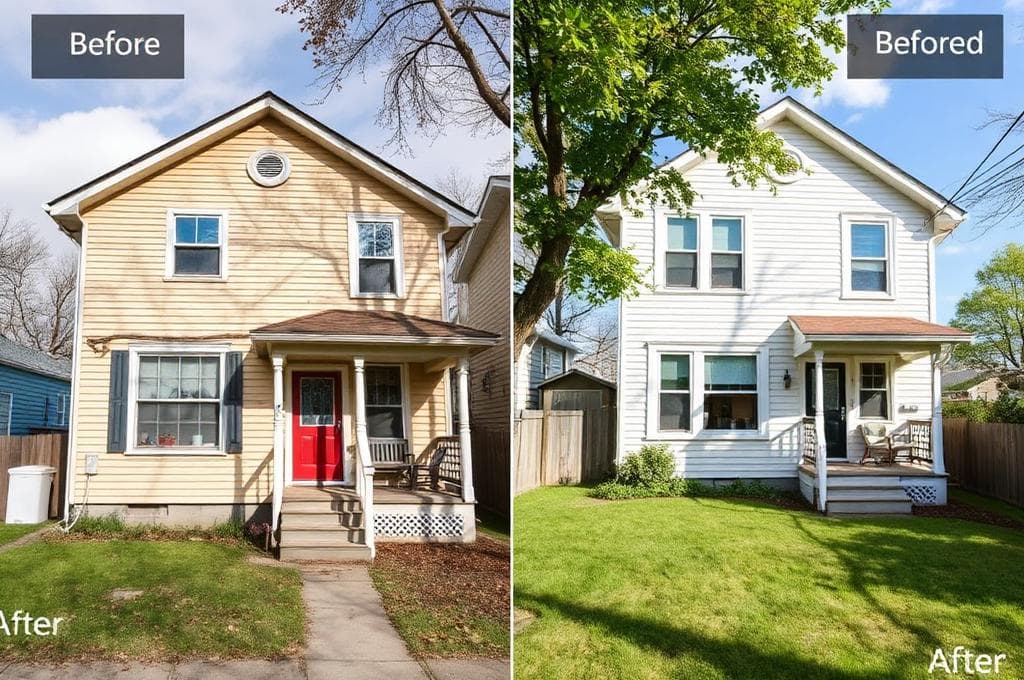
The reality of house flipping: understand true costs, timeline overruns, market timing risks, and when flipping actually makes money vs. destroys wealth.
Key Takeaways
- House flipping is harder than TV shows: average profit is $10,000-$30,000, not $100,000
- Use 70% rule to check deals: offer no more than (ARV × 0.70) - renovation - profit target
- Timeline overruns are the #1 killer: each month delay adds $2,000-$5,000 in carrying costs
- Hidden costs (permits, staging, photography, utilities) add $7,500-$19,600 not in budgets
- Market timing risk is uncontrollable: a 20% market drop kills profitability
Why House Flipping Looks Easy (But Isn't)
This is an important real estate decision, and you deserve clarity, confidence, and expert guidance every step of the way.
HGTV shows flip homes in 8 episodes. Reality: a good flip takes 6-12 months with challenges monthly. Media glamorizes the profits, ignoring the 50% that lose money or barely break even.
Studies show 85-90% of house flips are profitable. Sounds great, until you learn the average profit is only $10,000-$30,000 net (not $100,000 as TV suggests). When you factor in risk, time, and stress, many flippers would earn better returns in the stock market.
The Numbers: Why Flipping Often Fails
Example: flip a $300,000 house
- Purchase price: $300,000
- Down payment (25%): $75,000
- Renovation budget: $80,000
- Carrying costs (6 months at 8% interest on $300,000): $12,000
- Utilities/insurance during flip: $2,000
- Realtor commission on resale (5-6%): $18,000-$21,600
- Closing costs on resale: $3,000-$5,000
- Total invested: $490,000-$492,600
Now, what if the market shifts? You planned 6-month flip, now taking 9 months (carrying costs increase $6,000). You budgeted $80,000 renovations, but bid $95,000. You expected to resell for $420,000, but market dropped and you get $410,000.
In this scenario, you've invested $490,000 and the home sells for $410,000. You've lost $80,000 before accounting for capital gains taxes. The flip destroyed wealth instead of building it.
The 70% Rule: Checking If Flip Makes Sense
The 70% rule: offer no more than 70% of after-repair value (ARV) minus renovation costs minus profit target.
Formula: Maximum offer = (ARV × 0.70) - Renovation costs - Profit target
Example: House will be worth $420,000 after renovation. Renovation cost: $80,000. You want $40,000 profit.
Maximum offer = ($420,000 × 0.70) - $80,000 - $40,000 = $294,000 - $80,000 - $40,000 = $174,000
You'd need to purchase for $174,000 to make $40,000 profit. If asking price is $300,000, you can't make the deal work at 70% rule. Move on.
Many flippers ignore 70% rule because they want the deal. Then they lose money. Discipline is crucial.
Renovation Timeline Overruns: The #1 Flip Killer
Planned timeline: 6 months. Realistic timeline: 8-10 months. Why delays happen:
- Contractors are slow or unreliable (1-2 months delays common)
- Supply chain delays (materials not available, backorders)
- Scope creep: you find issues during renovation (rotten wood, electrical problems, mold)
- Permit delays: city approval takes longer than expected
- Unexpected repairs: you budgeted for some, but problems surface: foundation crack, sewer line damage, asbestos
- Financing delays: construction lender funding slow, appraisal delays
Each month of delay = $2,000-$5,000 in additional carrying costs. A 3-month delay costs $6,000-$15,000 extra. Your $40,000 profit becomes $25,000-$34,000.
Hidden Costs Flippers Forget
- Permit and inspection fees: $1,000-$3,000
- Dumpster rental: $300-$800
- Temporary utilities (electricity): $500-$1,000
- Insurance during construction: $1,000-$2,000
- Landscaping (after renovation): $2,000-$5,000
- Staging before sale: $1,000-$3,000
- Professional photography: $300-$600
- Appraisal (for resale): $400-$600
- Realtor commission negotiation: 5-6% of sale price
- Property taxes during holding period: $1,000-$3,000 (depends on location, duration)
These hidden costs add $7,500-$19,600 not in your budget. A profitable flip becomes breakeven when you include them.
Market Timing Risk: You Can't Control It
You plan to flip in 6-8 months. But market crashes 20% during your renovation. Your projected $420,000 resale is now $336,000. Your $40,000 profit becomes a $64,000 loss.
Flippers have zero control over market timing. The stock market can drop 20% in months. Real estate can too. If you flip and market crashes before sale, you lose money or take a loss.
Buy-and-hold investors aren't worried about 6-month market swings. Flippers are completely exposed.
When Flipping Actually Works
Flipping works when:
- You buy 20%+ under market (using 70% rule successfully)
- You know contractors (negotiate better prices, reliable timelines)
- You self-manage renovation (not hiring expensive project manager)
- Market is strong/stable (low risk of price drop during 6-9 months)
- You have cash reserves for overruns and contingencies
- You understand true costs (including hidden ones)
- You have thick skin for 8+ months of stress and problems
Even with all these, profit margins are often only $20,000-$50,000 on $400,000+ investment. That's 5-12% return over 8 months, or 8-18% annualized. Stock market returns 10% average. Flipping risk is higher for similar return.
Buy-and-Hold vs. Flip: Which Builds More Wealth?
Flip: $80,000 profit over 8 months after $75,000 down payment. $80,000 profit = 106% return over 8 months, or 159% annualized. Sounds great until you realize: that's gross profit, not net. After taxes (25%), you net $60,000. After time and stress, you're earning $7,500/month for being a project manager.
Buy-and-hold: $500,000 property, $75,000 down, $500/month cash flow. Over 8 months: $4,000 cash flow. Over 30 years: $180,000 cash flow + $500,000 appreciation = $680,000 wealth building with minimal active work.
Flipping has high short-term return but high risk and time. Buy-and-hold has lower return but builds massive long-term wealth with lower risk.
The Psychological Toll
Flipping is stressful: contractors are slow, problems surface constantly, carrying costs feel real, market uncertainty looms. After 8 months of stress for $60,000 net profit ($7,500/month), many flippers realize they'd rather have passive income through buy-and-hold.
What to Do Next
- Never offer more than 70% rule calculation—discipline is crucial
- Budget renovation costs with 20-30% contingency buffer
- Plan 8-10 months timeline (not 6 months)
- Get 2-3 contractor bids; choose reliable one, not cheapest
- Budget hidden costs: permits, utilities, insurance, staging, photography
- Have cash reserves for overruns—don't stretch financially
- Understand market is beyond your control—avoid flipping in uncertain markets
- Compare flip returns to buy-and-hold—is the risk worth it?
- Start with one flip to learn before committing to multiple
Have questions about house flipping the honest guide to costs, timelines, and profits? The team at Thrive.RealEstate is here to help — no obligation, no pressure. We believe everyone deserves expert guidance through life's biggest real estate decisions.
Action Checklist
HomeBase — Clear answers. Real people.
What to do next
This article is part of Buying an investment property, step 1: What am I trying to get out of this: cash flow, appreciation, or both?